


Department of Crop & Soil Sciences
The Department of Crop and Soil Sciences at Washington State University serves the Land Grant tradition by offering nationally competitive undergraduate and graduate education programs, conducting fundamental and applied plant and soil research, and extending the science of our disciplines to serve the public.
Apply Today
#75
US News and World Report places WSU at #75 for Best Global Universities for Agriculture Sciences.
#59
QS World University Rankings for Agriculture and Forestry places WSU at #59 worldwide.
Degree and Certificate Options
Master’s Degree (MS) or Doctoral Degree (PhD) in Crop Science
Crop Science specialization areas include Plant Genetics and Crop Breeding, Crop Physiology, and Crop Ecology, Management and Production. While students may elect to specialize in one area, excellent opportunities are available for the development of graduate research projects integrating two or more areas.
Master’s Degree (MS) or Doctoral Degree (PhD) in Soil Science
Soils may be studied either as natural bodies or as a medium for chemical and biochemical interactions for transport of water, solutes and heat, and for plant growth. Washington State University is located in one of the best geographical areas in the world for the study of soils as naturally occurring bodies. Graduate programs are usually designed to specialize in the physical, chemical, biological, mineralogical, geomorphological, or fertility aspects of the soil system.
Graduate Certificate in Sustainable Agriculture
The Graduate Certificate in Sustainable Agriculture provides post-baccalaureate students with an interdisciplinary understanding of practices and current issues in sustainable agriculture, along with the science that makes it work. Students who earn the Graduate Certificate in Sustainable Agriculture may take these skills into all industries and agencies involved in the food chain; from production, processing, and delivery to policy, regulation, and education.
Undergraduate Certificate in Organic Agriculture
The Certificate in Organic Agriculture is an 18-credit undergraduate program that can be taken along with a major in another field, or as a stand-alone educational experience. The certificate is ideal for professionals working in agriculture or related fields who require in-depth knowledge of organic systems, those wanting to pursue a career in organic agriculture, anyone interested in beginning a community supported agriculture (CSA) enterprise, home gardeners, as well as current WSU students in other majors at WSU with an interest in organic agriculture.
Department News

Alumni establish endowment to support WSU organic farm for years to come
The new $150,000 endowment will primarily support educational experiences for students, including paid internships. It will also help the farm cover staff and equipment costs.
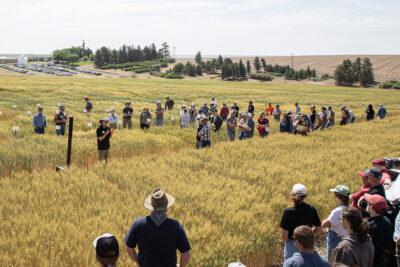
108th Lind Field Day to help growers during challenging season
Scientists will walk dryland grain growers through discoveries that could save fuel, fertilizer, and other input costs at WSU’s longest-running field day.
New from Extension: Idling production in a vineyard, annual operations at Wilke Farm
The newest bulletins from Washington State University Extension help viticulturists understand how to idle vineyard production for a few years and offer an annual overview of operations at the Wilke Research and Extension Farm.